Wednesday, 29 January 2014

Historic Centre of Telč, Czech Republic (UNESCO)

http://whc.unesco.org/en/list/621

The houses in Telc, which stands on a hilltop, were originally built of wood. After a fire in the late 14th century, the town was rebuilt in stone, surrounded by walls and further strengthened by a network of artificial ponds. The town's Gothic castle was reconstructed in High Gothic style in the late 15th century.

Sender: Ondras, Sent on: 27 Dec, 2013, Received on: 13 Jan, 2014, Travel time: 17 days

Historic Centre of Český Krumlov, Czech Republic (UNESCO)

http://whc.unesco.org/en/list/617

Situated on the banks of the Vltava river, the town was built around a 13th-century castle with Gothic, Renaissance and Baroque elements. It is an outstanding example of a small central European medieval town whose architectural heritage has remained intact thanks to its peaceful evolution over more than five centuries.

Sender: Ondras, Sent on: 27 Dec, 2013, Received on: 13 Jan, 2014, Travel time: 17 days

Mount Huangshan, China (UNESCO)

http://whc.unesco.org/en/list/547

Huangshan, known as 'the loveliest mountain of China', was acclaimed through art and literature during a good part of Chinese history (e.g. the Shanshui 'mountain and water' style of the mid-16th century). Today it holds the same fascination for visitors, poets, painters and photographers who come on pilgrimage to the site, which is renowned for its magnificent scenery made up of many granite peaks and rocks emerging out of a sea of clouds.

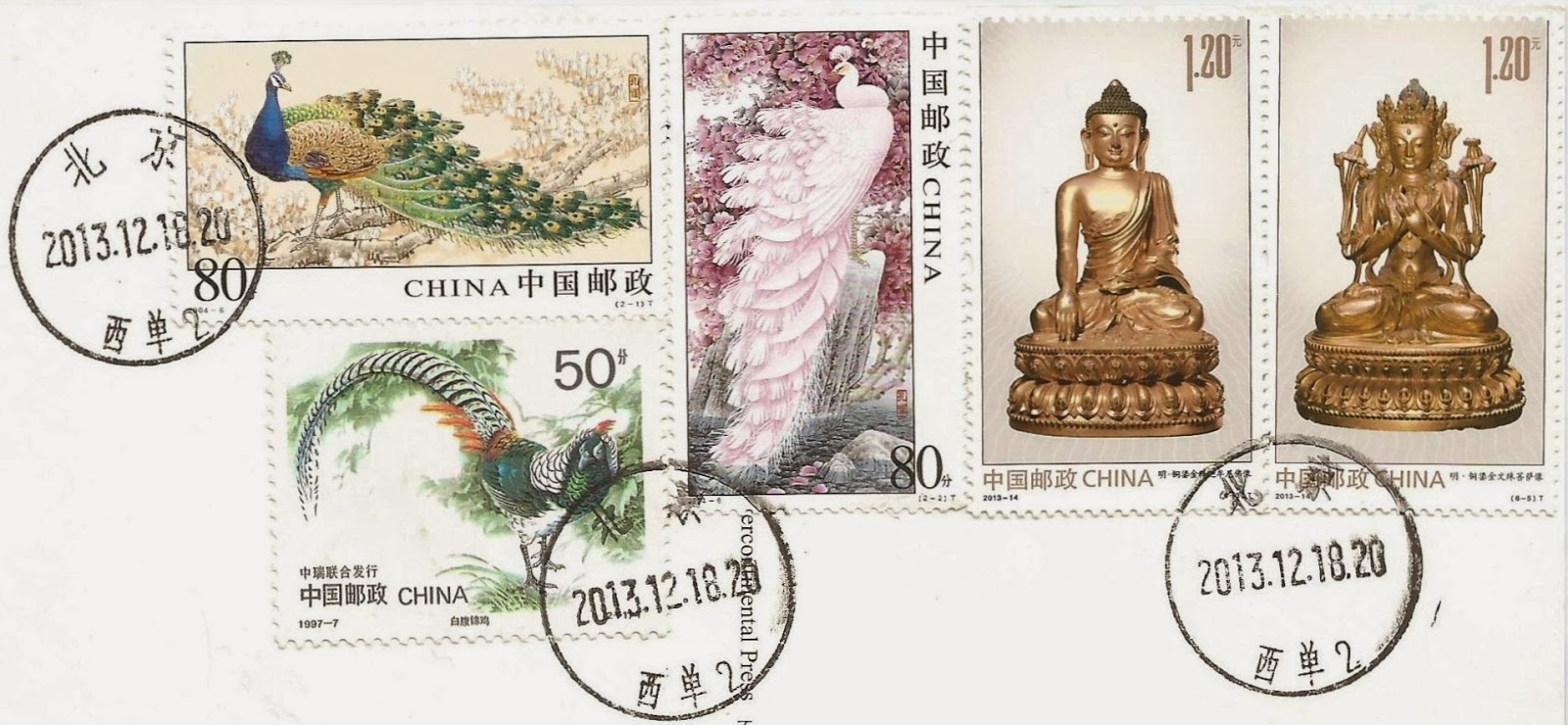
Sender: LillyPan, Sent on: 6 Dec, 2013, Received on: 6 Jan, 2014, Travel time: 30 days

Imperial Palaces of the Ming and Qing Dynasties in Beijing and Shenyang, China (UNESCO)

http://whc.unesco.org/en/list/439

Seat of supreme power for over five centuries (1416-1911), the Forbidden City in Beijing, with its landscaped gardens and many buildings (whose nearly 10,000 rooms contain furniture and works of art), constitutes a priceless testimony to Chinese civilization during the Ming and Qing dynasties. The Imperial Palace of the Qing Dynasty in Shenyang consists of 114 buildings constructed between 1625–26 and 1783. It contains an important library and testifies to the foundation of the last dynasty that ruled China, before it expanded its power to the centre of the country and moved the capital to Beijing. This palace then became auxiliary to the Imperial Palace in Beijing. This remarkable architectural edifice offers important historical testimony to the history of the Qing Dynasty and to the cultural traditions of the Manchu and other tribes in the north of China.

Sender: SuperLainey, Sent on: 16 Dec, 2013, Received on: 20 Jan, 2014, Travel time: 35 days

Dazu Rock Carvings, China (UNESCO)

http://whc.unesco.org/en/list/912

The steep hillsides of the Dazu area contain an exceptional series of rock carvings dating from the 9th to the 13th century. They are remarkable for their aesthetic quality, their rich diversity of subject matter, both secular and religious, and the light that they shed on everyday life in China during this period. They provide outstanding evidence of the harmonious synthesis of Buddhism, Taoism and Confucianism.

Sender: xiaomomo, Sent on: 18 Dec, 2013, Received on: 27 Jan, 2014, Travel time: 40 days

Historic Centre of Brugge, Belgium (UNESCO)

http://whc.unesco.org/en/list/996

Brugge is an outstanding example of a medieval historic settlement, which has maintained its historic fabric as this has evolved over the centuries, and where original Gothic constructions form part of the town's identity. As one of the commercial and cultural capitals of Europe, Brugge developed cultural links to different parts of the world. It is closely associated with the school of Flemish Primitive painting.

Sender: Anne, Sent on: 16 Dec, 2013, Received on: 06 Jan, 2014, Travel time: 21 days
Sent from France

Timgad, Algeria (UNESCO)

http://whc.unesco.org/en/list/194

Timgad lies on the northern slopes of the Aurès mountains and was created ex nihilo as a military colony by the Emperor Trajan in AD 100. With its square enclosure and orthogonal design based on the cardo and decumanus, the two perpendicular routes running through the city, it is an excellent example of Roman town planning.

Sender: Nihad, Sent on: 31 Dec, 2013, Received on: 21 Jan, 2014, Travel time: 22 days