Wednesday, 29 January 2014

Lapland, Finland

Lapland is the largest and northernmost of the regions of Finland.

Sender: eevaanneli, Sent on: 22 Dec, 2013, Received on: 14 Jan, 2014, Travel time: 23 days

Bronze Age Burial Site of Sammallahdenmäki, Finland (UNESCO)

http://whc.unesco.org/en/list/579

This Bronze Age burial site features more than 30 granite burial cairns, providing a unique insight into the funerary practices and social and religious structures of northern Europe more than three millennia ago.

Sender: Sipi, Sent on: 16 Dec, 2013, Received on: 4 Jan, 2014, Travel time: 19 days

Wadden Sea, Denmark (UNESCO)

http://whc.unesco.org/en/list/1314

This is an extension of the Dutch and German Wadden Sea site, inscribed on the World Heritage List in 2009. The Wadden Sea is the largest unbroken system of intertidal sand and mud flats in the world. The complete extension now covers most of the Danish Wadden Sea maritime conservation area, as well as a maritime extension of the Dutch Wadden Sea Conservation Area and the German Wadden Sea National Parks of Lower Saxony and Schleswig-Holstein.

Postcard 1: Danish Wadden Sea Nature and Wildlife Reserve, part II, Esbjerg
Sender: operagirl, Sent on: 27 Oct, 2014, Received on: 4 Jan, 2014, Travel time: 69 days

Flag of the Czech Republic


The national flag of the Czech Republic is the same as the flag of the former Czechoslovakia. Upon the dissolution of Czechoslovakia the Czech Republic kept the Czechoslovak flag while the Slovak Republic adopted its own flag. The first flag of Czechoslovakia was based on the arms, and was white over red. This was identical to the Flag of Poland, so a blue triangle was added at the hoist. The flag was banned by the Nazis in 1939, and a horizontal tricolor of white, red, and blue was enforced. The original flag was restored in 1945.

Sender: martinkan, Sent on: 4 Jan, 2014, Received on: 13 Jan, 2014, Travel time: 9 days

Kutná Hora: Historical Town Centre with the Church of St Barbara and the Cathedral of Our Lady at Sedlec, Czech Republic (UNESCO)

http://whc.unesco.org/en/list/732

Kutná Hora developed as a result of the exploitation of the silver mines. In the 14th century it became a royal city endowed with monuments that symbolized its prosperity. The Church of St Barbara, a jewel of the late Gothic period, and the Cathedral of Our Lady at Sedlec, which was restored in line with the Baroque taste of the early 18th century, were to influence the architecture of central Europe. These masterpieces today form part of a well-preserved medieval urban fabric with some particularly fine private dwellings.

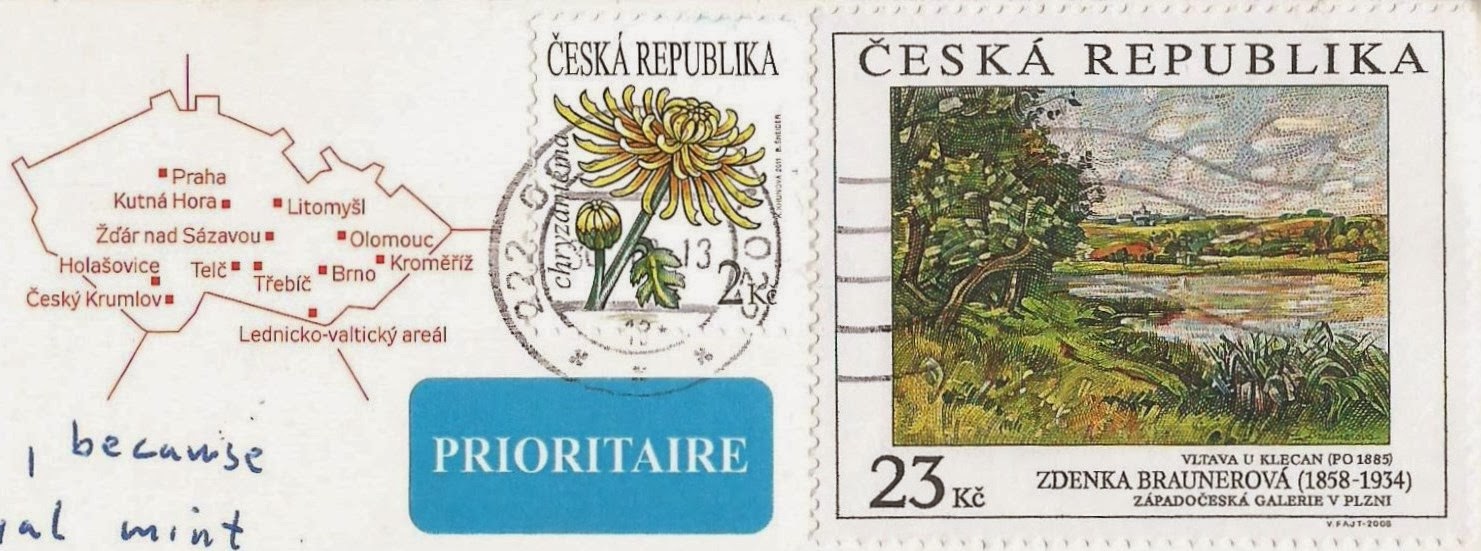
Sender: Ondras, Sent on: 27 Dec, 2013, Received on: 13 Jan, 2014, Travel time: 17 days

Jewish Quarter and St Procopius' Basilica in Třebíč, Czech Republic (UNESCO)

http://whc.unesco.org/en/list/1078

The ensemble of the Jewish Quarter, the old Jewish cemetery and the Basilica of St Procopius in Trebíc are reminders of the co-existence of Jewish and Christian cultures from the Middle Ages to the 20th century. The Jewish Quarter bears outstanding testimony to the different aspects of the life of this community. St Procopius Basilica, built as part of the Benedictine monastery in the early 13th century, is a remarkable example of the influence of Western European architectural heritage in this region.

Sender: Ondras, Sent on: 27 Dec, 2013, Received on: 13 Jan, 2014, Travel time: 17 days

Holašovice Historical Village Reservation, Czech Republic (UNESCO)

http://whc.unesco.org/en/list/861

Holašovice is an exceptionally complete and well-preserved example of a traditional central European village. It has a large number of outstanding 18th- and 19th-century vernacular buildings in a style known as 'South Bohemian folk Baroque', and preserves a ground plan dating from the Middle Ages.

Sender: Ondras, Sent on: 27 Dec, 2013, Received on: 13 Jan, 2014, Travel time: 17 days